Friday, 26 January 2024

Research: Basic Ceramic Tools


 In this stage of researching I would like to know a little bit more about ceramic materials and tools that I could use to make my projects. In the future, I think I will also do research about local shops and the equipment that they have because I think could be useful if I am out of materials and don't have time to order something online. 


Towels and Apron


An apron is useful when you don't want to dirty your own clothes. Ceramic mass itself is a dirty mass, but dust left on tables and tools during the creation can also leave visible dirt. It is a mass that can be washed off, but the apron will definitely help you avoid unnecessary dirt.
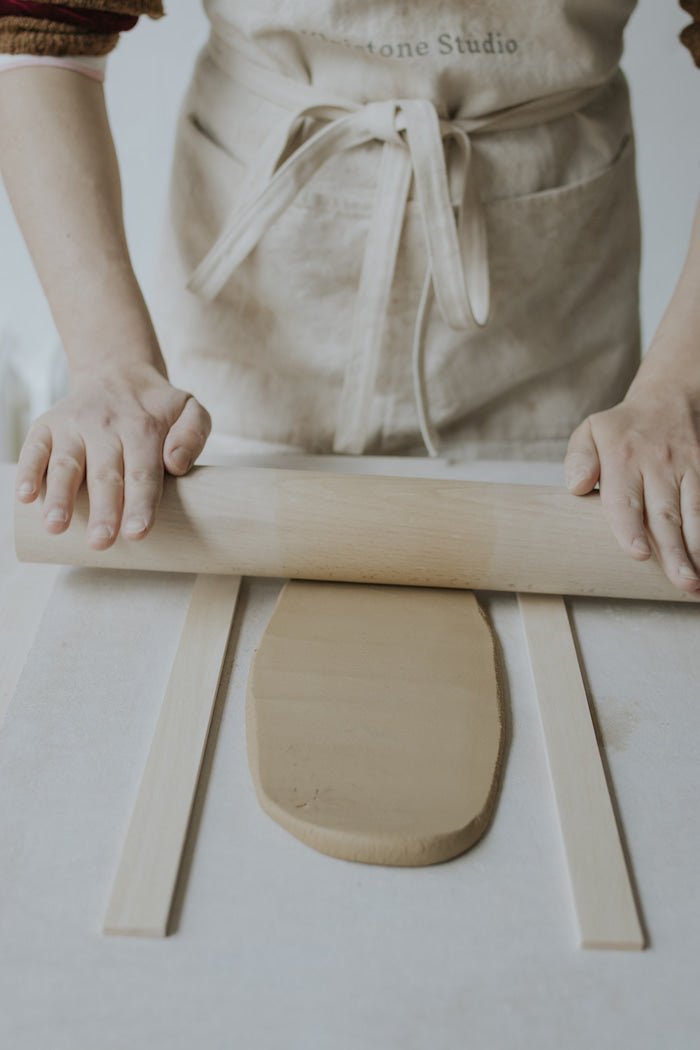
The towels are placed on the table before the process of rolling out the ceramic mass. This helps prevent the mass from sticking to the table. The towel makes it easier to work with the mass during fighting.


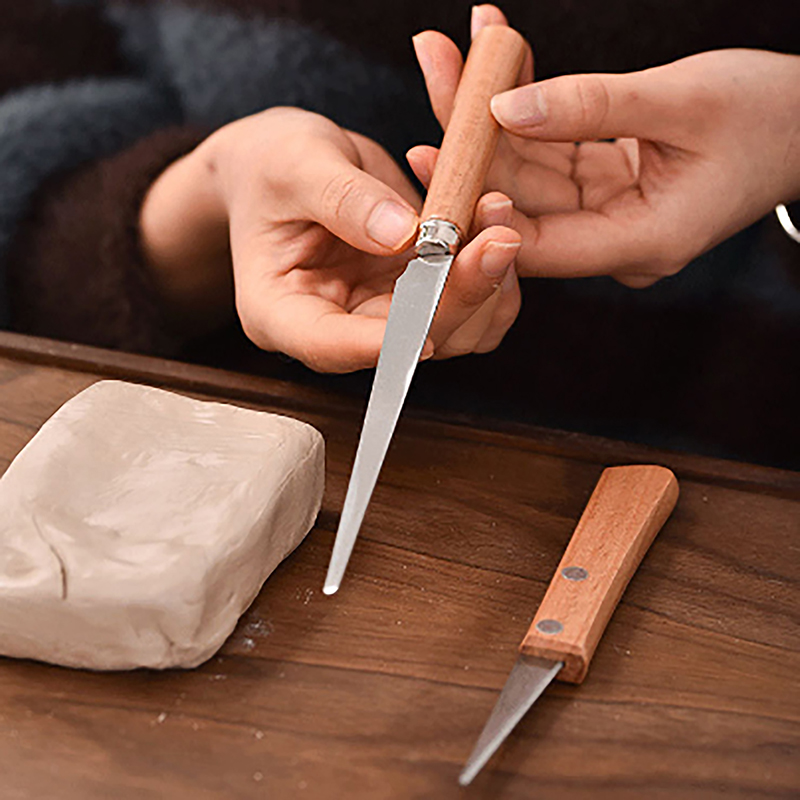
These knives are available with two versions of blades: soft and hard. Softer blades are more flexible, making them easier to bend, which can make it easier to cut more complex patterns. Hard ones are not so flexible, which makes it easier to maintain a confusing angle or cut more precise lines.

Wooden slats


These are thin wooden strips that are used to determine the height when rolling the ceramic mass. They act as a kind of guide for the fight.

Ribs and Scrapers


These tools help in smoothing the ceramic mass. They are also helpful when forming the mass on the potter's wheel. Could be used when working with manual mass improvement. These tools can smooth the edges of glued-together parts of the ceramic mass, making the place where the parts are joined smooth and invisible.

Loop, Wire, and Ribbon Tools


Useful tools when cutting ceramic mass, for example when finishing a vessel to straighten the ending. They can be used to cut out recesses, holes, and patterns, and also to cut a ceramic product in half (using a wire). Also useful when cutting out patterns, e.g. in the scraffito technique, in which you cut out delicate patterns.

References:

Peterson, B. (2019b). A Quick Guide to Basic Pottery Tools. [online] www.thesprucecrafts.com. Available at: https://www.thesprucecrafts.com/survey-of-basic-pottery-tools-2746328 [Accessed 26 Jan. 2024].

Mussi, Susan . “Ceramic Dictionary - by Susan Mussi: SLATS.” Ceramicdictionary.com, ceramicdictionary.com/en/s/581/slats#:~:text=Slats%20are%20thin%20pairs%20of. Accessed 26 Jan. 2024.

Thursday, 25 January 2024

Artist Research: Nigel Hoyle


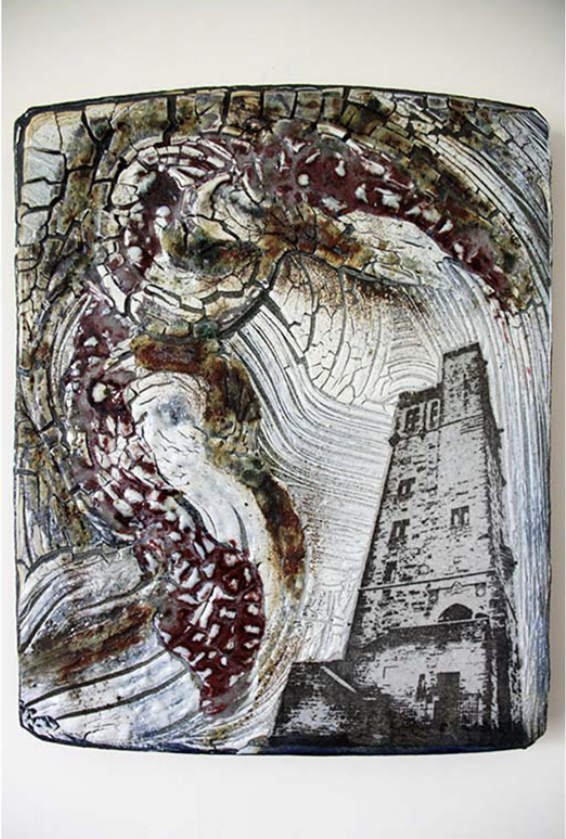
Nigel Hoyle -Art Teacher and Ceramicist living in West Yorkshire. His ceramic panels (example photo below ) are sold in the price range of 75£-850£. He also creates pottery, sculptures and pots. 


What caught my attention in N. Hoyle's works was the effect of cracks in the ceramics forming interesting patterns. They reminded me of the patterns on the wings of a dragonfly or a butterfly, for example. This is something unusual that I hopefully could use in my project. His works are unique, combining colours and cracks with screen-printed images to create a unique final impression. I need to expand my technical knowledge regarding this technique. These cracks and imperfections also remind me of nature. Since primitivism is the theme that my works are inspired by, I consider it an interesting connection to my works. The whole creation process seems slightly complicated, so I am considering using a glaze that will give a similar visual effect, instead of imitating the process given by the author of the work.

On the author's website I even found a technical explanation of how to achieve this effect. In terms of current technical knowledge, it doesn't tell me much, but I'm sure I'll use this knowledge when I create a project. "All of my panels, diptychs, triptychs and pentaptychs are individual works of art, signed and one-offs.    Please take a look at some of my other panels, diptychs and triptychs  in my Victoria  Series collection.  The panels are fired to 1250 C with a plain black and transparent glaze where there is a screen-printed image featured. Then a thick porcelain slip is applied with mark-making around the resisted image.  This is manipulated to control the process of cracking. Several glazes and raw materials are then added to define the mood and atmosphere of the piece. It is then re-fired to 1260 C during which the textures take hold in the re-melted glazes." Hoyle (no data). 

References:

Nigel Hoyle Ceramics. (n.d.). Victoria Exhibition Portfolio Panel by Nigel Hoyle Ceramics. [online] Available at: https://nigelhoyleceramics.co.uk/product/victoria/ [Accessed 25 Jan. 2024].

magicrockbrewing.com. (n.d.). Town Lager - Love Local. [online] Available at: https://magicrockbrewing.com/blogs/news/town-lager-love-local.

Marsh, I. and Robison, J. (2010). Slab Techniques. A&C Black., p.12

Wednesday, 24 January 2024

Artist Research: George Bowes

George Bowes

George Bowls (born 1961 in Ohio) is a current ceramics artist. George Bowls (born 1961 in Ohio) is a current ceramics artist. In the initial stage of his studies at the Cleveland Institute of Art, he wanted to become a painter, but the institute offered interesting ceramics workshops that completely absorbed him. due to which he changed his direction and chose ceramics as his main subject. I cant find any information about how he created his sculptures. I think it could be also slab technique construction, same as he could use a potter's wheel for make it.   


In Bowes's work, I am inspired by how he creates his works in non-obvious, irregular shapes. In my project, I also want to focus on shapes that will differ from the basic ones. For example, a blue vessel, resembles paintings, and its shape adapts to the shape of the picture and not the other way around, in the sense that it is not a basic vase with a drawn frame, but this vessel is currently the frame of the picture.

I'm thinking about combining repeated shapes and motifs that make up the whole. The colours used in the artist's works are too bright for me. My designs are inspired by the era of impressionism and post-impressionism, so when choosing colours I will focus on more subdued colours, mainly blue.


References

Bowes, G. (2013). Serving Bowl - George Bowes. [online] The Rosenfield Collection. Available at: https://www.rosenfieldcollection.com/b136/ [Accessed 24 Jan. 2024].

1stDibs.com. (n.d.). Contemporary Modern Memphis Signed Ceramic Art Vase Vessel George Bowes 1990s. [online] Available at: https://www.1stdibs.com/furniture/decorative-objects/vases-vessels/vases/contemporary-modern-memphis-signed-ceramic-art-vase-vessel-george-bowes-1990s/id-f_17842001/#zoomModalOpen [Accessed 24 Jan. 2024].

Stories, L. (2019). Check out George Bowes’ Artwork - Voyage Houston Magazine | Houston City Guide. [online] voyagehouston.com. Available at: https://voyagehouston.com/interview/check-george-bowess-artwork/ [Accessed 24 Jan. 2024].

www.themarksproject.org. (n.d.). Bowes | The Marks Project. [online] Available at: https://www.themarksproject.org/marks/bowes [Accessed 24 Jan. 2024].

Project Sign Off

 Sign Off


While discussing the project, the teacher suggested that I could switch from working with glass to epoxy resins. I find this to be a great change for my project. The resin is a transparent product and goes hard after drying, making it easier to work with. Also, we negotiated that we change six 2d projects and one 3d project to 3-4 2d projects and 3-4 3d projects because it's more suitable for my future degree- Crafts Design, where my major task will be doing 3d projects. The teacher also assured me that she would help me accelerate my induction to ceramics workshops, as I had never dealt with this material before. 

My next steps are to do some research about famous artists who work with ceramics and also check my target audience for this project.

Thursday, 18 January 2024

Initial Reaserch: Artists and their paintings

My project is inspired by the works of famous artists, mainly from the Impressionist and Post-Impresionist periods. When selecting my works, I pay attention to blue and green colors. This is because I would like to use opalite or a blue shade of glass as a transparent material. The first work that is inspired is Claude Monete's painting "Sunrise".

Claude Monet "Sunrise" (1872)

This famous painting depicts a sunrise in the French port of Le Havre. Orange and yellow shades are shown in contrast with dark objects. The work has very delicate, even sketchy brush strokes, so much so that the canvas itself is visible in places. The artist himself considered the work unfinished. Currently, Monet's "Sunrise" is considered one of the most outstanding works of Impressionism.  
However, my color inspiration from this work is delicate shades of blue and green.

Claude Monet's "Water Lilies" (1906)

During 29 years (1897-1926) Claude Monet painted about 250 paintings depicting aquatic nature, mainly: Water lilies. Throughout his career, the artist often focused on one aspect, and painted from different perspectives, in a different aspect. His works from this water nature series are considered stunning, although the artist was already struggling with his eyesight due to worsening cataracts.
I am inspired by the wonderful shades of blue, smoothly turning into green. The entire color composition is stunning and I plan to use it as inspiration in my project.


Detail of Sky

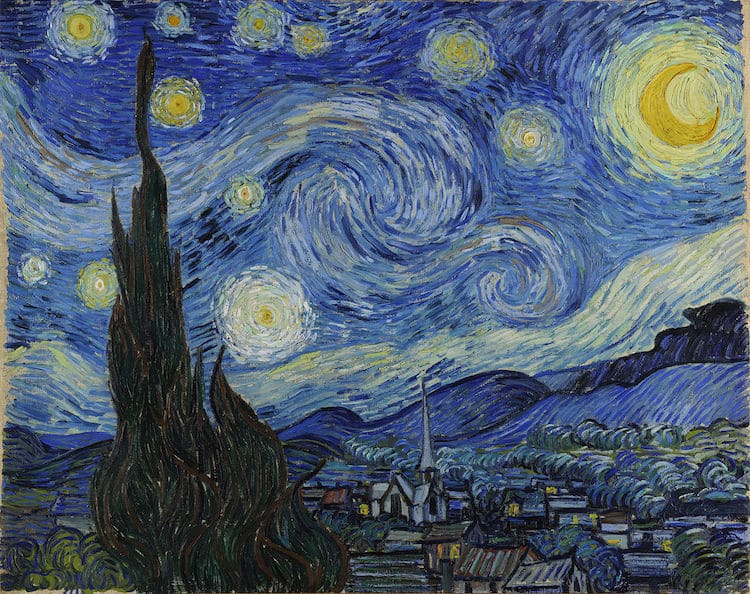
Vincent van Gogh painted many impressive works in his short career. The Starry Night is one of his most outstanding works. The village featured in the painting is the place where the artist stayed. More specifically, it is a view from the window of a psychiatric hospital in France. The artist's well-known mental problems had a major impact on the artist's work. 
My attention was attracted by the combination of the dark sky with radiant stars and the moon. The freedom with which Van Gogh painted the sky, and delicate and very detailed brush strokes giving different shades of blue and yellow gave a wonderful effect. It reminds me of the technique called sgraffito, which is used in ceramic products.

References:

(No date a) Impression sunrise by Claude Monet. Available at: https://www.claude-monet.com/impression-sunrise.jsp (Accessed: 18 January 2024). 

King & McGaw. (n.d.). Impression, Sunrise by Claude Monet - art print from King & McGaw. [online] Available at: https://www.kingandmcgaw.com/prints/claude-monet/impression-sunrise-354578#354578::border:50_frame:880603_glass:770007_media:1_mount:108644_mount-width:50_size:618 [Accessed 18 Jan. 2024].

Monet's Water Lilies: Their History and Evolution | Art&Object. (n.d.). Art&Object. https://www.artandobject.com/news/monets-water-lilies-their-history-and-evolution

My Modern Met. (2018). Art History: How Van Gogh’s ‘The Starry Night’ Came to Be and Continues to Inspire Artists. [online] Available at: https://mymodernmet.com/starry-night-van-gogh/.

DiamondCore Tools. (n.d.). How To Make Sgraffito Pottery. [online] Available at: https://diamondcoretools.com/blogs/resources/how-to-make-sgraffito-pottery.

Wednesday, 17 January 2024

Portfolio One: Project Statement

  In my project for AP1, I will focus on the primitivism theme. The final result will be six 2D works and one final 3D work. In my project I would like to combine the play of light and shadows using transparent materials, also I'm interested in animal motifs, especially insects. I would like to combine them into one. When it comes to the materials I would like to use in the project, for the current research, I was thinking about opal, colored glass as a part of the transparent part, and ceramics as the basic material. When it comes to colors, I would like to transfer colors with the works of famous artists from the period of impressionism. That will be colors for the base - ceramics, with colorful transparent accessories- glass. I was also considering using a 3D printer to make ready-made cutouts in the shape of a selected insect, in ceramic mass, or a roller with a pattern. The symbols on the pattern would refer to primitivism, in which symbols were assigned their own meaning. I think it could add more precision and details to my work. My inspiration in creating my work is the works of artists from the Impressionism period. 

As a ready-made 3D project, I intended to create ceramic pottery with insect motifs in a simple, primitive form. The body part of which will be replaced with transparent materials. As a result, I want to create pottery that, under the influence of light, will show differences between light and shadows. 

Examples of famous artists from the Impressionist period:

z


References:

Japan, T. (2023) 10 Japanese patterns (Wagara) steeped in history and their traditional meaningBECOS. Available at: https://en.thebecos.com/blogs/column/10-japanese-patterns-steeped-in-history-and-their-traditional-meaning (Accessed: 11 January 2024). 

The umbrellas (renoir) (2023) Wikipedia. Available at: https://en.wikipedia.org/wiki/The_Umbrellas_(Renoir) (Accessed: 18 January 2024). 

Monet, C. (1970) Water LiliesThe Art Institute of Chicago. Available at: https://www.artic.edu/artworks/16568/water-lilies (Accessed: 18 January 2024). 

Developing Ideas


The task in these classes was to choose one of many items as an object for inspiration. My choice was a bag with small decorative stones, such as those used for, for example, flower pots. At least that was my first thought. I chose them because of their unpredictable, non-obvious shapes and unique patterns.


While looking through the shapes I noticed that one type of stone had quite an interesting shine, which drew my attention to the element of light and its reflection/passing in front of objects. Then I started thinking about using this element in my project. Or more precisely, use light and shadows together. I haven't decided yet on the specific direction to use, but I know that I would like to use transparent material and colors to create a play of light, shadows, and colors. At first, I thought about the usual shapes of lamps, as my first association was a lamp, but then I started using the shape of the selected stone as a basis. It was a stone with an exceptionally thin side, which gave me the idea to use it as a row for lights. The exceptionally flat front of the stone could serve as a place for an imprinted pattern, an element for a painting, or as a base for more 3D options. These are the first, rough ideas that I hope will lead me further over time.


The next thing I thought of, looking at the irregular shapes of the stones, I thought of a children's play space. Their imagination has no limits and I think that such stone-shaped seats/blocks could have an interesting impact on their creativity. They could also be used as irregularly shaped pillows that would adapt to the current need for relaxation/play.


I consider it an interesting option, but what appeals to me more is the first idea that came to me while looking at the stone - light.

Reflection: Art Portfolio 2

     In Art Portfolio 2, I learned techniques for developing ideas. The classes showed me how to evolve,  my ideas, and change and improve ...